
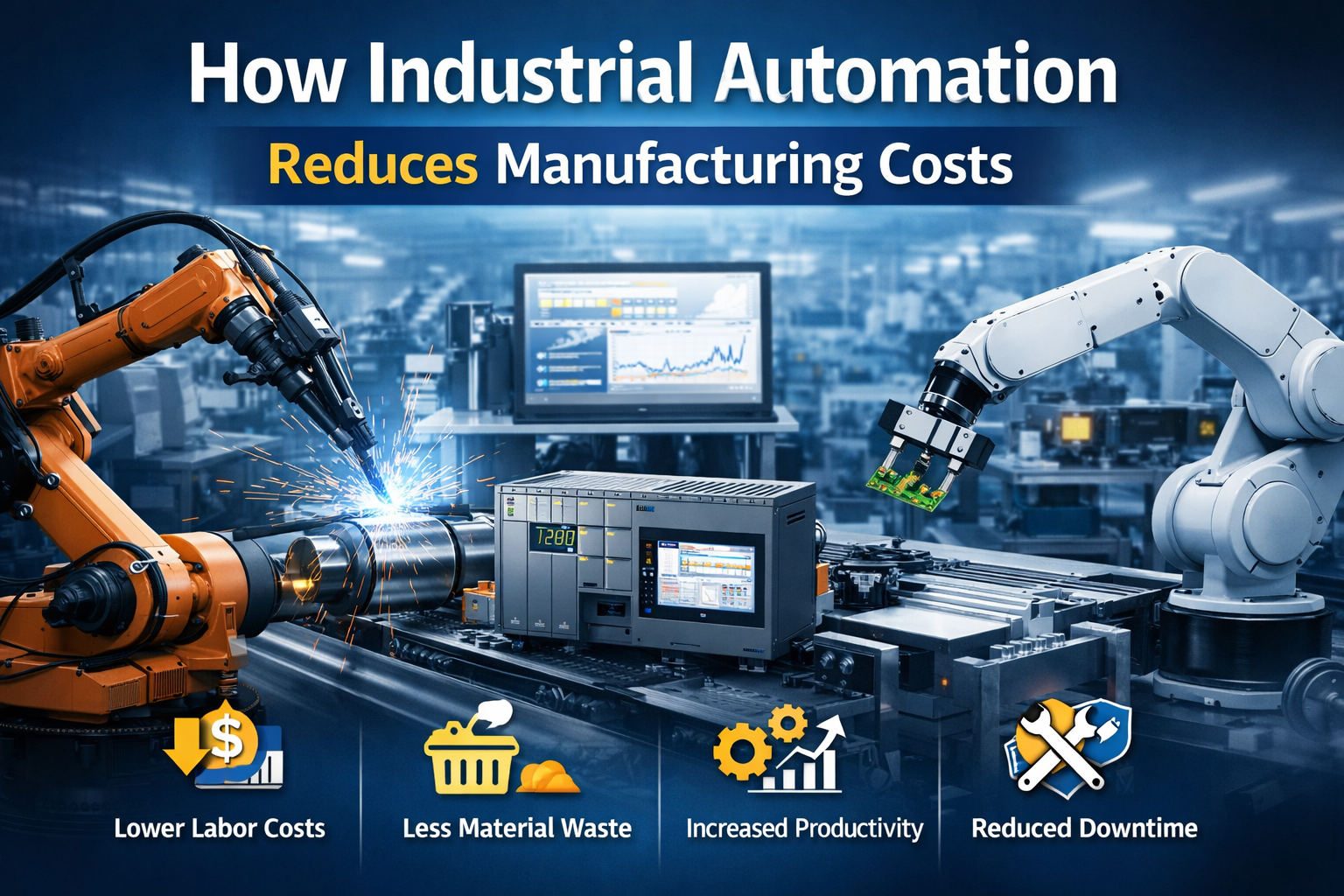
Manufacturing has always been about efficiency. The companies that produce more, waste less, and deliver consistent quality are the ones that stay competitive. Over the past two decades, industrial automation has become one of the most powerful ways to achieve those goals. By integrating robotics, PLC controllers, sensors, and intelligent control systems, manufacturers can significantly reduce operating costs while improving productivity.
Automation is not just about replacing manual labor. It is about building smarter production environments that operate more efficiently and with greater reliability.
Lower Labor Costs Without Reducing Productivity
Labor is often one of the largest expenses in manufacturing. Many production processes require repetitive tasks such as assembly, inspection, packaging, and material handling. These tasks consume valuable human time and can lead to fatigue and errors.
Automation allows machines and robotic systems to perform repetitive operations with high precision and speed. Instead of assigning multiple workers to perform the same repetitive activity, automated equipment can handle the workload consistently.
Employees can then focus on supervision, quality control, maintenance, and process improvement. This shift allows manufacturers to maintain or increase production output while controlling labor costs.
Reduced Waste and Material Loss
Even small inefficiencies in a manufacturing process can lead to large financial losses over time. Human errors, inconsistent measurements, and improper handling of materials often result in scrap, rework, or rejected products.
Automated systems perform tasks with exact specifications every cycle. Sensors and PLC controlled processes monitor parameters such as temperature, pressure, positioning, and timing. This precision minimizes variations that lead to defects.
The result is less wasted material, fewer rejected products, and improved yield from the same raw materials.
Increased Production Speed
Automation dramatically increases production speed. Machines and robotic systems can perform tasks faster than manual operations while maintaining accuracy.
A process that might require several operators working in shifts can often be performed by an automated system running continuously. Production lines equipped with automated conveyors, robotic arms, and control systems can operate efficiently throughout the day and night.
Higher throughput means more products produced in the same time period, which reduces the cost per unit.
Lower Maintenance and Downtime Costs
Modern automation systems include sensors and monitoring tools that provide real time information about equipment performance. This data allows maintenance teams to detect early signs of wear or malfunction before major failures occur.
Predictive maintenance strategies reduce unexpected downtime and costly emergency repairs. Instead of shutting down a production line because of equipment failure, companies can schedule maintenance during planned downtime.
Over time this leads to more reliable operations and lower maintenance costs.
Improved Workplace Safety
Industrial environments often involve heavy machinery, hazardous materials, and physically demanding tasks. Workplace injuries can lead to medical costs, insurance claims, and lost productivity.
Automation allows robots and machines to handle dangerous or repetitive tasks such as lifting heavy objects, operating in high temperature environments, or working in confined spaces.
A safer work environment reduces accidents and improves employee morale while lowering long term operational costs.
Better Use of Data and Process Optimization
One of the most valuable benefits of industrial automation is the ability to collect and analyze production data. Automated systems continuously generate information about machine performance, cycle times, product quality, and operational efficiency.
Managers and engineers can use this data to identify bottlenecks, optimize workflows, and improve overall process efficiency. Over time these improvements compound and result in significant cost savings.
Automation turns manufacturing operations into data driven systems where decisions can be based on real performance metrics rather than assumptions.
The Role of Automation Components
Behind every automated production line is a network of industrial components such as PLC controllers, sensors, relays, drives, and communication modules. These components work together to control machines, monitor conditions, and ensure that processes operate smoothly.
Reliable automation infrastructure is critical for maintaining efficient operations. When components fail or systems require upgrades, access to high quality industrial parts becomes essential.
At NXGParts.com, we supply a wide range of industrial automation components that support manufacturing operations, maintenance teams, and system integrators. From control modules to replacement parts, having dependable components helps ensure that automated systems continue running without disruption.
Automation as a Long Term Investment
While implementing automation requires an initial investment, the long term financial benefits are substantial. Companies that automate their processes often see lower operating costs, higher productivity, and improved product quality.
Manufacturers that delay automation may find themselves competing with organizations that can produce faster and more efficiently.
Industrial automation is no longer a luxury reserved for large corporations. It has become a practical and necessary strategy for companies that want to remain competitive in a rapidly evolving manufacturing landscape.
As technology continues to advance, automation will play an even greater role in shaping the future of manufacturing. Businesses that begin adopting these technologies today are positioning themselves for greater efficiency, stability, and long term success.